About this stencil
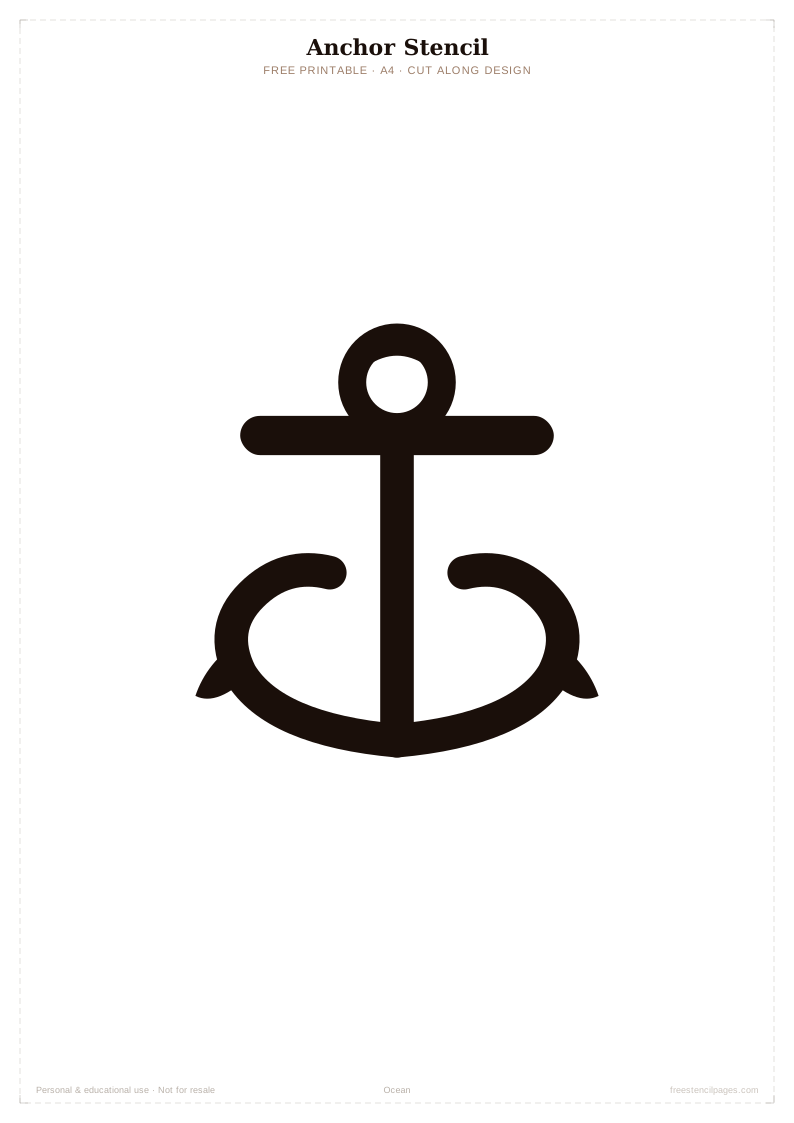
The anchor is a genuinely easy stencil to use, which makes it a good choice for people who want a quick, satisfying result without a lot of technical fuss. The design is almost entirely composed of thick, bold lines with good bridge connections — there's very little that can go wrong during cutting or application, and even imperfect edges tend to look intentional rather than clumsy on such a graphic shape.
It also works at an unusually wide range of scales. A small anchor at 30% of A4 sits perfectly on a gift tag or luggage label. The same design scaled to 120% becomes a strong statement on a coastal bathroom wall. The proportions hold at every scale, which is harder to achieve in stencil design than it looks.
The nautical context is an obvious one, but the anchor has a broader appeal than just coastal decoration. In a more contemporary context — dark navy on white, or white on dark navy — it has a clean graphic quality that reads as design-conscious rather than themed. That versatility is worth noting if you're trying to avoid the full driftwood-and-rope aesthetic.
Best surfaces & materials
This design works across a wide range of surfaces. Here's what tends to give the best results on each one.
| Surface | Recommended paint | Notes |
|---|---|---|
| Tote bags and fabric | Fabric paint or acrylic with fabric medium | Navy on white canvas is the classic; heat-set for washability |
| Coastal bathroom wall | Chalk paint or emulsion | Navy or dark teal; works well in groups of three at different scales |
| Wooden crate or box | Chalk paint | White on raw wood, or dark paint on a light wood for a more graphic look |
| Ceramic tiles or pottery | Ceramic paint | Seal with ceramic varnish once dry; requires smooth tile surface |
| Gift tags and cards | Acrylic | Small scale (30–40%), navy or metallic gold on cream card |
How to use this stencil — step by step
Whether you're printing and cutting this yourself or uploading to a Cricut, these steps apply to most surfaces and paint types.
- Choose your scale based on the surface. Gift tags: 30–40%. Fabric bags or cushions: 70–80%. Wall feature: 100–120%.
- The anchor cuts easily at all scales. Scissors will do the job for most applications; a craft knife gives cleaner results on the rope detail at the top.
- Secure the stencil. For fabric: tape around the edges. For walls and wood: low-tack spray adhesive on the back.
- Apply paint with a sponge or foam brush — the anchor's bold shapes mean a sponge works particularly well here, giving an even coverage with minimal risk of bleed.
- Two coats usually give better coverage than one, especially over dark backgrounds. Allow the first to dry slightly before the second.
- Peel cleanly and allow to dry. Clean the stencil immediately if reusing in the same session.
The navy trio: print the anchor at three sizes — 50%, 80%, 100%. Apply them in a loose cluster on a coastal bathroom wall in navy chalk paint on white, leaving slightly irregular spacing between them. It looks like a considered design choice rather than a repeating pattern, and takes about 20 minutes.
Project ideas for this design
Not sure where to start? These are some of the most popular ways people have used this particular stencil.
Nautical tote bag
Large navy anchor on natural canvas. The single most popular use for this stencil. Add a rope motif in rope twine glued around the handles for extra detail.
Coastal bathroom feature
Three anchors at different scales, grouped on a bathroom wall in dark navy on white. Works particularly well above a basin.
Painted wooden crate
White anchor on a dark-stained wooden crate. Used for blanket storage or as a display piece in a coastal living room.
Personalised gift wrap
Scattered small anchors in navy on kraft paper. Add a stripe in white along the edge. Quick, personal, and looks nothing like shop-bought wrapping.
Ceramic mug or bowl
Use ceramic paint and seal. A small anchor on a plain white mug makes a thoughtful handmade gift with minimal effort.
Related stencils you might like
Frequently asked questions
Is the anchor stencil good for a bathroom?
Yes — it's one of the most popular choices for coastal bathroom decoration. Apply in chalk paint on a smooth wall surface. Use a nearly-dry brush, apply two thin coats, and seal with a clear varnish in a bathroom environment to protect against steam and moisture.
Can I use the anchor stencil on a mug or ceramic?
Yes, with ceramic paint. Clean and dry the mug surface thoroughly, apply the stencil with low-tack tape (spray adhesive is too permanent for ceramics), use a sponge to apply ceramic paint, peel while damp, and seal with ceramic varnish once fully dry.
What's the easiest surface to start with for the anchor stencil?
A plain canvas tote bag with fabric paint. The fabric is forgiving, the stencil applies easily with a sponge, and the result is satisfying from a first attempt. It's also one of the most useful finished items — a stencilled tote bag actually gets used.
How large should the anchor be for a feature wall?
For a single anchor as a bathroom feature, 100–120% of A4 (roughly 25–30cm tall) works well. If you're doing a group of three at different sizes, scale them to 50%, 80% and 110% of A4.