About this stencil
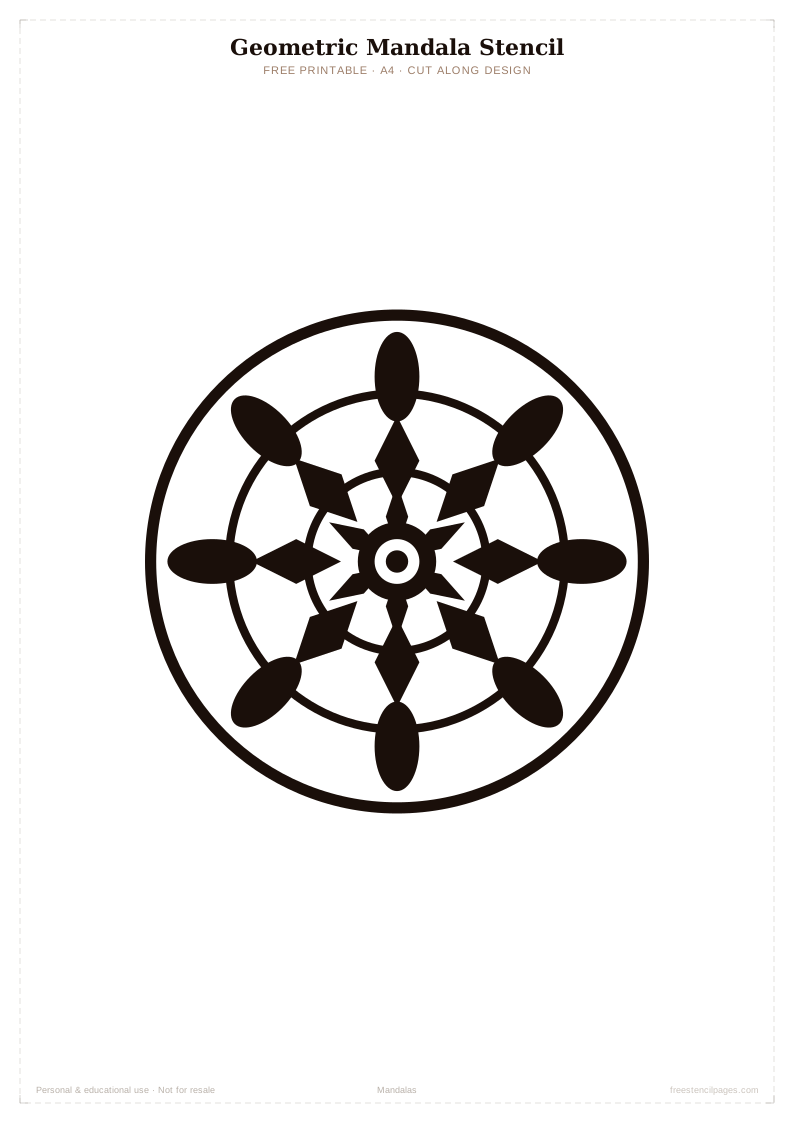
Let's be honest about the difficulty rating. The mandala is marked hard not because the stencilling technique itself is especially challenging, but because the design has many fine lines and small geometric elements that are all completely unforgiving. When every element is perfectly symmetrical, any imperfection — a slightly wobbly line, a smudge of paint bleed — is immediately visible in a way it wouldn't be on a more organic design.
That said, it's absolutely achievable with the right preparation. The key differences between a mandala that looks beautiful and one that looks like a mess are: a surface that's completely smooth and dry, low-tack spray adhesive applied to every millimetre of the stencil back, a brush that's dry enough to feel almost uncomfortable to use, and patience. If you're willing to apply four or five very thin coats rather than one or two medium ones, the result can be extraordinary.
The design itself has been drawn specifically for stencil use — the bridge widths are calibrated for cutting at A4 scale on card, with a small amount of tolerance for printing slight variations. The geometric symmetry means that even small imperfections are distributed across the design in a way that reads as regularity rather than error — which is part of why the mandala can work so well when it's done carefully.
Best surfaces & materials
This design works across a wide range of surfaces. Here's what tends to give the best results on each one.
| Surface | Recommended paint | Notes |
|---|---|---|
| Feature wall | Chalk paint or metallic emulsion | Gold on deep teal or navy is the most popular combination; requires very dry brush |
| Canvas | Metallic acrylic | Copper or gold on black gesso canvas; frame as artwork |
| Large wooden board | Chalk paint or acrylic | Transfer with spray adhesive; work on a horizontal surface if possible |
| Mirror or picture frame border | Metallic acrylic | Apply around the edge of a large mirror for an elegant frame effect |
How to use this stencil — step by step
Whether you're printing and cutting this yourself or uploading to a Cricut, these steps apply to most surfaces and paint types.
- The mandala is best applied to a smooth, flat, completely dry surface. Any texture will show in the fine geometric lines. If your wall has a rough texture, consider applying to canvas or MDF instead.
- Mark the centre point of your intended position with a very light pencil cross. The mandala needs to be centred precisely — a few millimetres off will be visible in the finished result.
- Apply repositionable spray adhesive generously to the entire back of the stencil. Press down firmly, working from the centre outward, ensuring every fine bridge is in contact with the surface.
- Use a barely-loaded round stencil brush — not a foam sponge, which can catch under the fine bridges. Tap off paint until the brush looks almost empty.
- Work in multiple very thin layers, allowing each one to dry slightly before the next. Four thin coats will give better results than one medium coat.
- Peel the stencil straight back slowly, keeping it parallel to the surface. Don't lever it up at an angle — this can pull paint off with it.
The gold-on-dark-wall approach: paint the wall section (about 80 × 80cm) in deep navy or charcoal first. Once completely dry, apply the mandala in metallic gold chalk paint using four very thin coats. The result looks like a commissioned piece of art. The contrast between the metallic and the dark background does most of the work — the stencil just has to be clean.
Project ideas for this design
Not sure where to start? These are some of the most popular ways people have used this particular stencil.
Above-sofa wall feature
Large mandala centred above a sofa in metallic gold on dark teal. The single most dramatic living room intervention you can make with a stencil.
Canvas wall art
Copper metallic on black gesso canvas. Frame in a simple dark frame. Genuinely gallery-quality if the application is clean.
Bedroom headboard feature
Mandala centred on the wall above a bed, in white on pale grey or gold on deep blue. Transforms a bedroom.
Yoga or meditation space
Large mandala on the wall facing a yoga mat. White on pale sage green. The symmetry and repetition is calming in a practice space.
Painted floor medallion
On a painted wooden or concrete floor, in the centre of a room. Requires good technique but makes an extraordinary statement.
Related stencils you might like
Frequently asked questions
Why is the mandala rated hard?
It has many fine lines and geometric elements that leave no room for imperfection — any smudge or bleed is immediately visible in a symmetrical design. The technique required isn't complex, but it demands very dry brush application and more patience than simpler designs.
What size should I print the mandala for a feature wall?
For a typical living room or bedroom wall, aim for 60–80cm diameter. This requires printing larger than A4 — take the SVG to a print shop for A1 or A0 output, or project the SVG onto the wall and trace. The SVG scales perfectly at any size.
Can I use a roller for the mandala stencil?
A small foam roller works if the roller is very lightly loaded. A round stencil brush generally gives more control over the fine geometric elements. Avoid a large flat brush, which is almost impossible to control in the tight sections.
How do I clean a mandala stencil between uses?
Wipe carefully with a barely damp cloth before the paint dries. Don't soak card stencils. For Mylar or acetate, rinse gently under running water and dry flat.