About this stencil
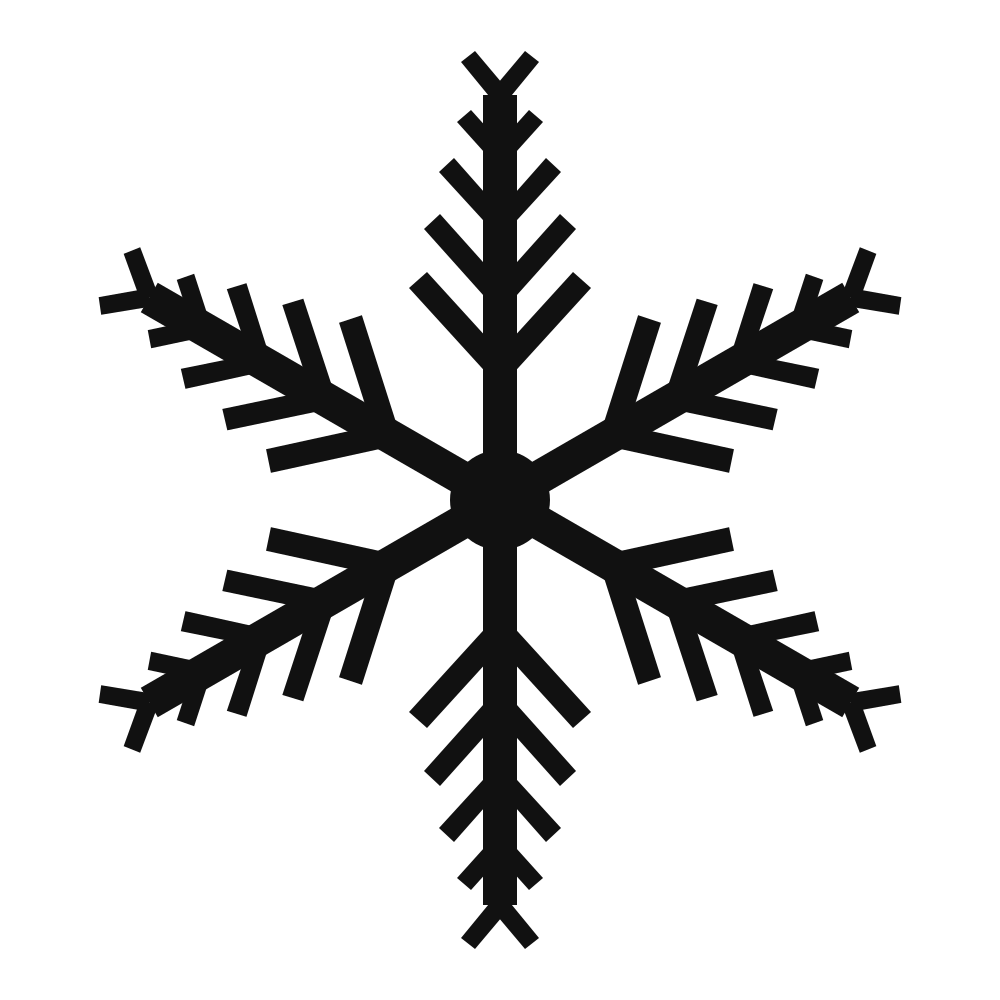
The fern snowflake is the most branched design in our Christmas collection, with branches at 32, 50, 68 and 85 percent of each arm, all at 42 degrees and each slightly shorter than the last. The effect is of six feathers meeting at a centre point. It still has full six-fold symmetry, but because the branches are so regular the eye reads texture rather than geometry, and that softness is what makes it sit comfortably on cloth.
Fabric is an unforgiving surface for stencils. The weave wicks paint sideways, the sponge drags fibres, and anything under about 3mm wide turns into a blur. We thickened this design twice during testing until the thinnest branch tip cleared 3.8mm at A4, which is wide enough to stay sharp on tea-towel cotton and smooth linen. On heavy canvas or knitted fabric you will want to print it larger, because the texture of the cloth starts to compete with the branches.
It is also, not coincidentally, the design that looks most like an actual snowflake photographed under a microscope. Fernlike stellar dendrites are the classic large crystals that fall on still, cold nights, and they are the ones people picture when they imagine snow.
Best surfaces & materials
Fabric first, then everything else. These are the combinations that have given the cleanest results.
| Surface | Recommended paint | Notes |
|---|---|---|
| Cotton tea towels | White or navy fabric paint, stencil brush | Print at 60%. Wash the towel first to remove sizing or the paint will not bond. |
| Linen cushion covers | Fabric paint, light sponge | Print at 100% for one large central snowflake. Insert card inside so paint does not bleed through. |
| Cotton napkins | Fabric paint, stencil brush | One at 35% in a corner of each napkin. Heat-set for five minutes per napkin. |
| Canvas tote bags | Fabric paint, foam roller | Print at 110% for heavy canvas; smaller branches get lost in the weave. |
| Paper and card | Watercolour or acrylic | Works, but the lace snowflake is finer for paper. Use the fern when you want texture. |
How to use this stencil — step by step
Stencilling fabric is mostly about preparation. The actual painting takes a minute; the steps either side are what decide whether the result is crisp.
- Wash and iron the fabric. New cotton and linen carry a finish called sizing that stops fabric paint bonding, and creases will print as gaps.
- Print at the right scale for the weave: 60% for tea towels, 100% for cushions, larger for canvas. Cut all four branch tiers, starting from the tips and working inwards.
- Place a sheet of card inside the item, or underneath a single layer, so paint cannot soak through to the back.
- Tape the stencil down at the arm tips with masking tape. Spray adhesive is tempting on fabric but can leave a residue that shows after washing.
- Use a nearly dry stencil brush and pounce straight down, never sideways. A sideways stroke pushes paint under the branches and into the weave.
- Lift the stencil while the paint is damp, let it dry for 24 hours, then iron on the reverse through baking paper for five minutes to heat-set.
Dark cloth, white snow: the fern snowflake is at its best in white or ivory fabric paint on navy, charcoal or forest-green linen. On a pale background the feathered branches can look fussy; on a dark one they look like frost. If the white comes out grey on the first coat, let it dry and pounce a second coat through the same stencil without moving it.
Project ideas for this design
Nearly every project here is something you can wash and reuse each December, which makes the fern snowflake unusually good value for an evening's work.
Navy tea towels
White fern snowflakes at 60%, two or three per towel. A genuinely good handmade gift that takes twenty minutes a towel.
Linen cushion cover
One snowflake at 100%, dead centre, in white on dark linen. Nothing else. Restraint again.
Christmas napkins
One small fern snowflake in a corner of each napkin, in silver on white or white on red. A set of six in an hour.
Hessian table runner
Print at 130% so the branches clear the coarse weave. White fabric paint, two coats.
Tote bags for teachers
Canvas tote, one large white snowflake, a name underneath using our letter stencils.
Related stencils you might like
Frequently asked questions
Why is this called a fern snowflake?
Because four evenly spaced branch pairs at the same angle make each arm look like a fern frond. Snow scientists use almost the same term, fernlike stellar dendrite, for the large feathery crystals that form on cold, calm nights.
Will the branches stay sharp on fabric?
On smooth cotton and linen, yes. We thickened the design so the thinnest tip is over 3.8mm at A4, which is wide enough to resist wicking. On heavy canvas or anything textured, print it 10 to 30% larger than you otherwise would.
Does fabric paint survive the wash?
Once heat-set, properly. Let the paint cure for 24 hours, then iron the back of the fabric through baking paper on a cotton setting for about five minutes. After that it will go through a normal 40 degree wash for years. Skip the heat-set and it will fade in two washes.
Can I cut the fern snowflake by hand?
Yes, but it is the most cutting in the set, with eight branches per arm. Cut from the outer tips inward so the card stays rigid for the fine parts, and change your blade halfway through. If you own a cutting machine this is the design to use it on.